Ceramic Fiber Tape with Aluminum: efficient thermal protection for industrial applications
In industry, temperature control is not only important to ensure the proper functioning of equipment, but also...
Read more
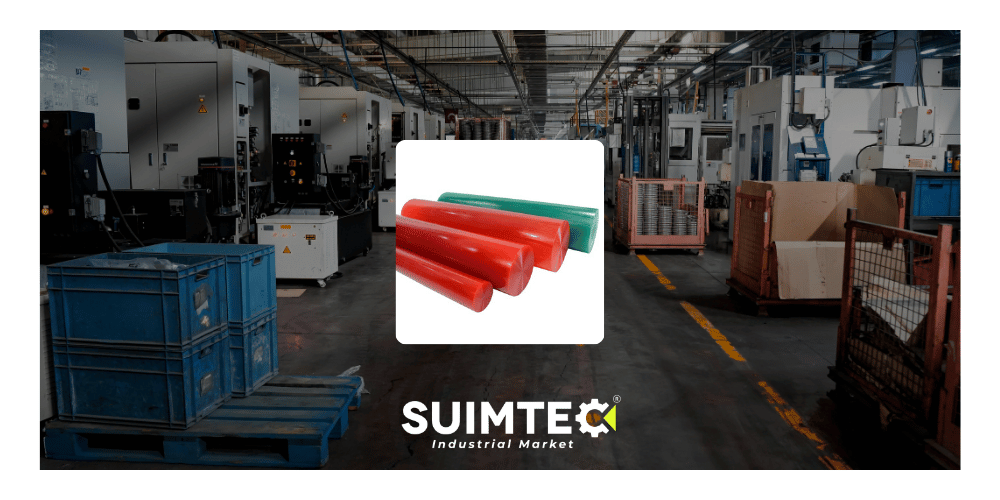
When an industrial application demands absorbing constant impacts, withstanding dynamic loads, and resisting continuous wear, few materials offer such a balanced performance as the Industrial polyurethane. Thanks to its combination of elasticity, mechanical strength and durability, this material has become a widely used solution in sectors where the reliability of components is fundamental to maintaining productivity.
Unlike other technical materials, polyurethane can work under severe conditions without losing its physical properties, allowing for reduced maintenance costs and increased equipment lifespan.
Polyurethane is an engineering elastomer developed to offer a unique combination of flexibility and strength. This characteristic allows it to absorb energy, resist deformation, and withstand mechanical stresses that could affect other materials.
For this reason, it is common to find components made of polyurethane in equipment subjected to vibrations, impacts and constant abrasion.
Its ability to adapt to different operating conditions makes it one of the most versatile materials in modern industry.
Integrated keywords: industrial polyurethane, polyurethane elastomer, industrial polyurethane material.
The main advantage of polyurethane is its ability to combine properties that are not normally found together in the same material.
While some materials offer great hardness but little flexibility, and others exhibit elasticity but low wear resistance, polyurethane manages to balance both factors.
This combination allows for the manufacture of more durable components with better performance under demanding working conditions.
Furthermore, it exhibits excellent elastic recovery, meaning it can be temporarily deformed and subsequently return to its original shape.
In many industries, premature wear of components represents one of the biggest operating costs.
Conveyors, rollers, loading systems, and heavy machinery operate constantly under conditions that generate friction and abrasion. When materials are unsuitable, replacements become frequent and disrupt production continuity.
Polyurethane has proven to be one of the best alternatives to address this problem thanks to its extraordinary resistance to wear.
Its performance in abrasive applications allows for a significant extension of the useful life of the parts and reduces maintenance times.
Integrated keywords: polyurethane wear resistance, abrasion-resistant polyurethane, resistant industrial materials.
Not all materials are capable of absorbing energy efficiently.
Polyurethane has a structure that allows it to absorb impacts and reduce vibrations generated by machinery or constant movement. This property helps protect equipment, reduce noise, and improve overall operating conditions.
For this reason, it is widely used in systems where vibration control and protection against repetitive shocks are required.
Integrated keywords: impact polyurethane, industrial damping, industrial vibration reduction.
The versatility of polyurethane has allowed its incorporation into multiple industries.
In mining, it is used for components subjected to extreme abrasion. In manufacturing, it is part of material handling and transport systems. In logistics, it is used in industrial rollers and wheels. It also has a significant presence in heavy machinery and applications related to damping and equipment protection.
Its ability to adapt to different industrial environments explains why it continues to be one of the most widely used elastomers worldwide.
Among the most common applications of polyurethane are:
• Wheels for loading equipment
• Wear-resistant coatings
• Damping elements
• Anti-vibration bases
• Components for material transport
• Impact protectors
Each of these applications takes advantage of one of the most important properties of the material: strength, elasticity, and durability.
Many companies choose polyurethane not only for its technical properties, but also for the positive impact it has on productivity.
When components last longer, replacements decrease, maintenance interventions are reduced, and equipment availability increases.
This improvement in operational continuity allows for the optimization of resources and better long-term results.
At Suimtec we offer Industrial polyurethane in different formats and applications, accompanied by specialized technical advice to select the best solution according to the specific conditions of each process.

In industry, temperature control is not only important to ensure the proper functioning of equipment, but also...
Read more
In any industrial process where liquids, gases, or steam circulate, an efficient sealing system is essential to maintain...
Read more English
  Español
  Français
  Português do Brasil
  简体中文
简体中文  日本語
日本語