Ceramic Fiber Tape with Aluminum: efficient thermal protection for industrial applications
In industry, temperature control is not only important to ensure the proper functioning of equipment, but also...
Read more
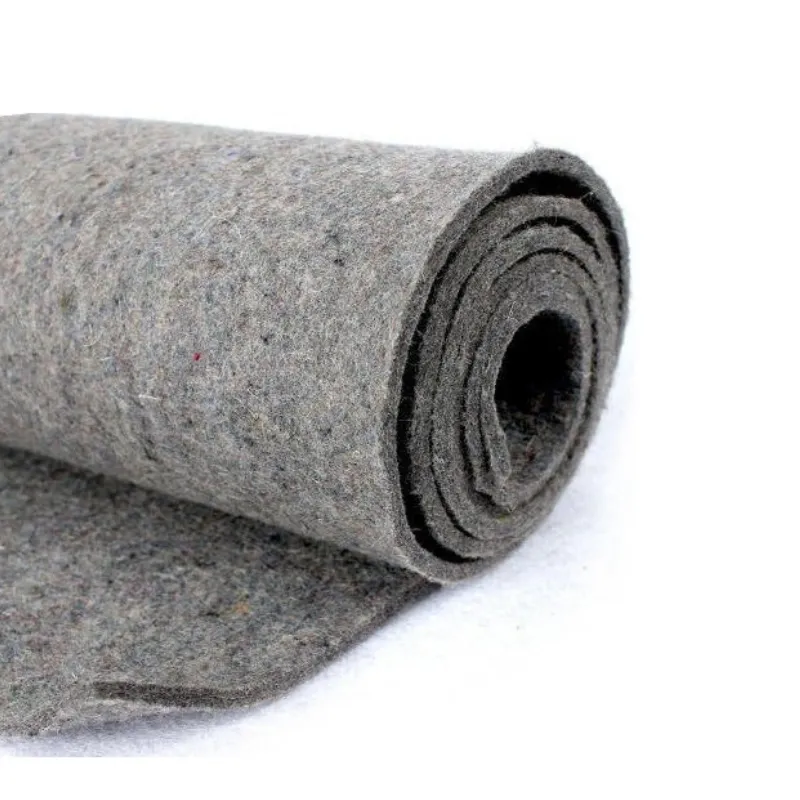
Industrial felt is a technical material widely used in production processes where absorption, cushioning, filtering, or surface protection is required. Although it may seem like a simple material at first glance, in industrial settings it fulfills strategic functions in machinery, maintenance, sealing, and vibration control.
Unlike decorative or artisanal felt, industrial felt is made from high-density pressed fibers, usually natural wool, synthetic fibers, or specific blends, designed to withstand demanding mechanical and environmental conditions. Its compact and uniform structure allows it to act as an insulator, lubricant retainer, or controlled friction element.
Industrial felt is a nonwoven material obtained by compacting fibers through pressure, moisture, and heat. This process creates a dense sheet with specific mechanical and absorption properties. In technical applications, it is available in various thicknesses and densities, depending on the intended use.
Its main characteristic is its ability to absorb impacts, retain liquids, and act as an intermediary between metallic or moving surfaces. In industrial environments, this translates into protection against wear, noise reduction, and improved mechanical performance.
Integrated keywords: industrial felt, technical felt material, industrial felt sheet.
The performance of industrial felt is based on its compact fibrous structure. Among its most relevant properties are its ability to absorb oils and lubricants, making it useful in contact lubrication systems; its damping properties against moderate vibrations; and its controlled friction resistance in applications where continuous contact is needed without damaging surfaces.
In addition, felt provides good thermal and acoustic insulation in specific applications, especially when used as an intermediate layer in metal structures or mechanical equipment.
Depending on its composition, it may offer additional resistance to heat or certain chemical agents, although it is always necessary to evaluate the environment of use before its selection.
Integrated keywords: industrial felt properties, oil absorption felt, cushioning felt.
The use of industrial felt extends to multiple sectors. In machinery, it is used as a lubricant retainer in shafts and bearings, helping to maintain constant lubrication and reducing wear. In mechanical systems, it acts as a controlled friction element, especially in equipment where smooth contact between parts is required.
It is also used as a surface protection material to prevent scratches on metal parts or delicate components during transport or assembly. In some cases, industrial felt acts as an auxiliary seal against dust or fine particles in environments where complete airtightness is not critical, but a basic barrier is required.
In the automotive and metalworking industries, felt can be found in applications such as light damping, sound absorption, or secondary structural support.
Integrated keywords: industrial felt applications, felt for machinery, felt as a lubricant retainer.
One of the main advantages of industrial felt is its versatility. It can be easily cut and adapted to different shapes and sizes, facilitating its integration into maintenance or manufacturing processes. Furthermore, its cost is usually competitive compared to other, more complex technical materials.
In applications where an engineering polymer or specialized elastomer is not required, felt can offer a functional, economical, and durable solution.
However, the selection should be made considering density, thickness, and operating environment. Not all felts offer the same performance, and an unsuitable choice can reduce their lifespan.
At Suimtec we offer industrial felt in different formats and technical specifications, adapted to applications of absorption, cushioning and mechanical protection in industrial environments.

In industry, temperature control is not only important to ensure the proper functioning of equipment, but also...
Read more
In any industrial process where liquids, gases, or steam circulate, an efficient sealing system is essential to maintain...
Read more English
  Español
  Français
  Português do Brasil
  简体中文
简体中文  日本語
日本語